Back
to Main
Back
to Main
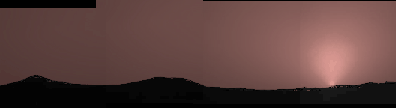
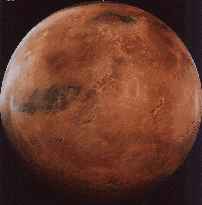
At this point in time, Areopaleontology (Martian Paleontology) is primarily concerned with proving that life is either existent or was existent on the surface of Mars. Since the formation of the planets, countless rocks and debris have been ejected from the surface of Mars and have made their way to the surface of our planet. Furthermore, rocks and surface material have also been obtained during unmanned missions to the surface of the Red planet.
It is this material that has underwent intense scrutiny by many different scientists to prove or disprove the existence of life on the surface of Mars. One particular meteorite, ALH84001, was discovered in Antarctica in 1984. It is particularly important because it was ejected from Mars's surface at a time when the surface of Mars was much warmer and contained massive amounts of water. At this point in time, it is thought that Mars's biosphere possibly contained the earliest forms of life.
Indeed, if this life was at one point in time existent, it could very well still be living today. Such life forms may still exist in the pores and spaces and cracks in rocks existing below the surface of the Red Planet. The reason for this theory is that scientists believe that the primordial water may still exist in these small areas.
Contemporary conditions on the surface of Mars are not hospitable to life as we know it. However, if scientists can find remnants or living specimens of life from the surface of Mars, it will be a great discovery for Areopaleontologists and Areopaleogenomicists. If such microbes or bacteria are found, their genomes can be identified.
The
identification of Martian genomes would be of great importance to the field
of Areopaleogenomics. If and when the genomes of ancient or contemporary
Martian life could be discovered, it could be compared to the genomic sequences
of life from the same area on Earth. By doing this, we could determine
if Terran life (on Earth) is unique or if there are any links between Terran
and Martian genomes.
Saint Louis College of Pharmacy Genomics Homepage